
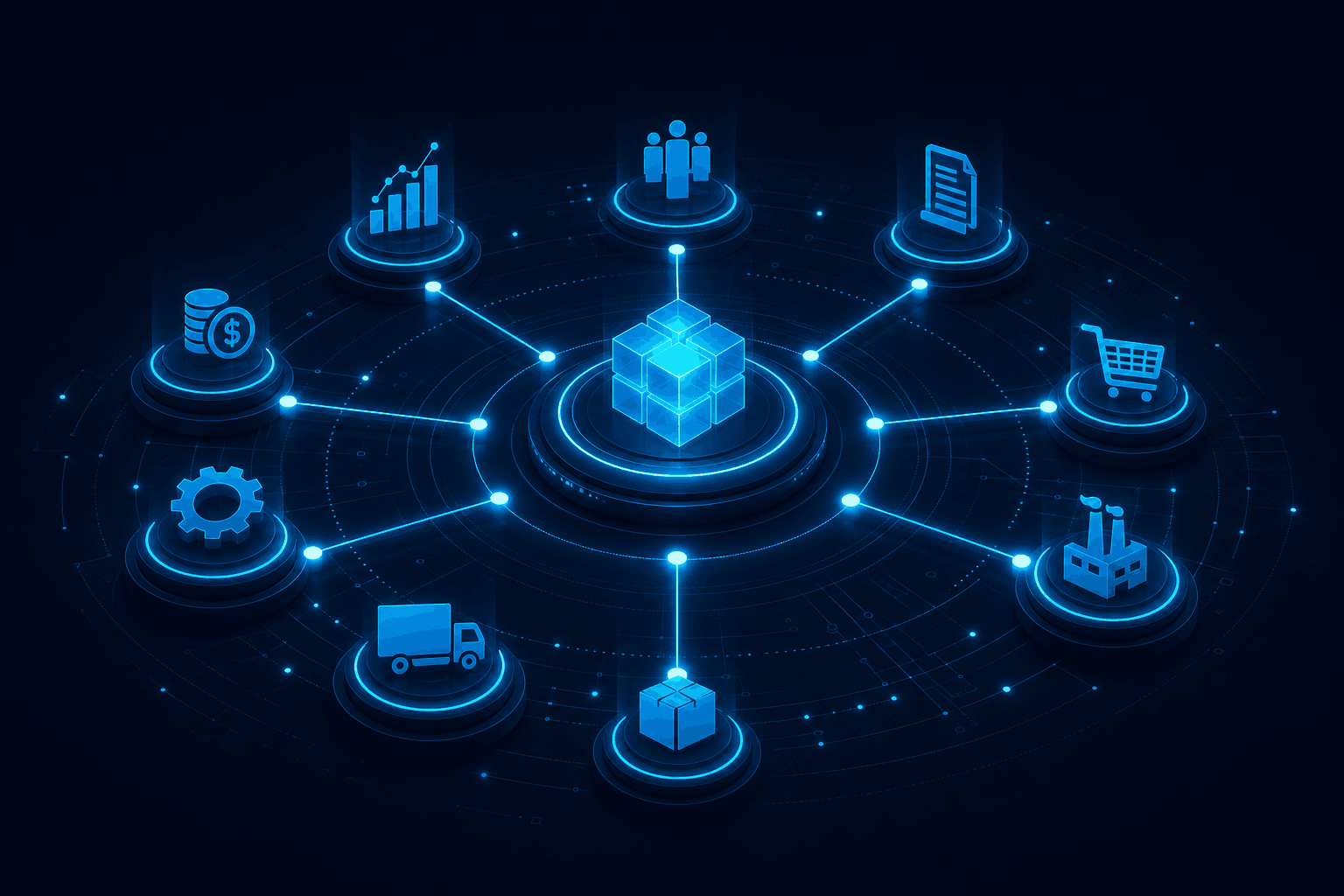
ERP stands for Enterprise Resource Planning. In short: a system that connects what happens in the company (stock, sales, purchases, invoices, sometimes HR and production) so you are not working from five conflicting spreadsheets. It is not “accounting software plus a logo.” It is the foundation operations run on. At UNICORE, when a standard ERP does not match your reality, custom software appears — modules and integrations around your process.
The orchestra analogy. Without a conductor, every instrument plays by ear: the warehouse thinks it has 100 units, sales sold 120, accounting invoices something else. The ERP is the score + the conductor: the same notes (data) for everyone. People do not disappear — they stop improvising on wrong data.
Which modules usually appear. Not every company turns everything on day one. Typical: stock and warehouse; sales / orders; purchases from suppliers; invoicing and the link to accounting; sometimes production, projects, or HR. The idea is one “truth” about product, customer, and document — not three parallel lists.
ERP vs. Excel vs. “we have a program.” Excel is great for ad-hoc analysis — poor as a system of record for 20 people. An isolated program (invoices only, stock only) fixes one slice. An ERP (or an ERP core + integrations) joins the slices. If the online shop, CRM, and warehouse do not talk, you need APIs and integrations — not just “another login.”
When an ERP (or a more serious core) is worth it. Signals: stock “does not match”; invoices lag because data arrives on WhatsApp; each department has another “official” spreadsheet; you hire people just to copy data. You do not have to buy the full enterprise pack on day one — sometimes an MVP on critical flows is healthier.
Common mistakes. (1) “We implement everything at once” — adoption dies. (2) You buy the license without mapping real processes. (3) You ignore training and an internal owner. (4) You think ERP = magic: if the process is chaotic, software makes chaos faster. IT consulting helps choose which modules, which data to migrate, and what to leave for later.
Standard ERP vs. custom. Off-the-shelf products cover ~80% of typical needs. Your difference (special flow, legal report, partner integration) may need extensions or apps beside the ERP. Decide upfront what is “core” and what is “custom” — so you do not pay twice for the same thing.
Conclusion. In plain language, an ERP is the system that keeps the company’s resources and documents in one narrative — not a pile of files. It is not only for corporations; it is for any organization that has outgrown Excel. If you are evaluating an ERP, an extension, or an integration, contact us — we clarify what to buy and what to build.