
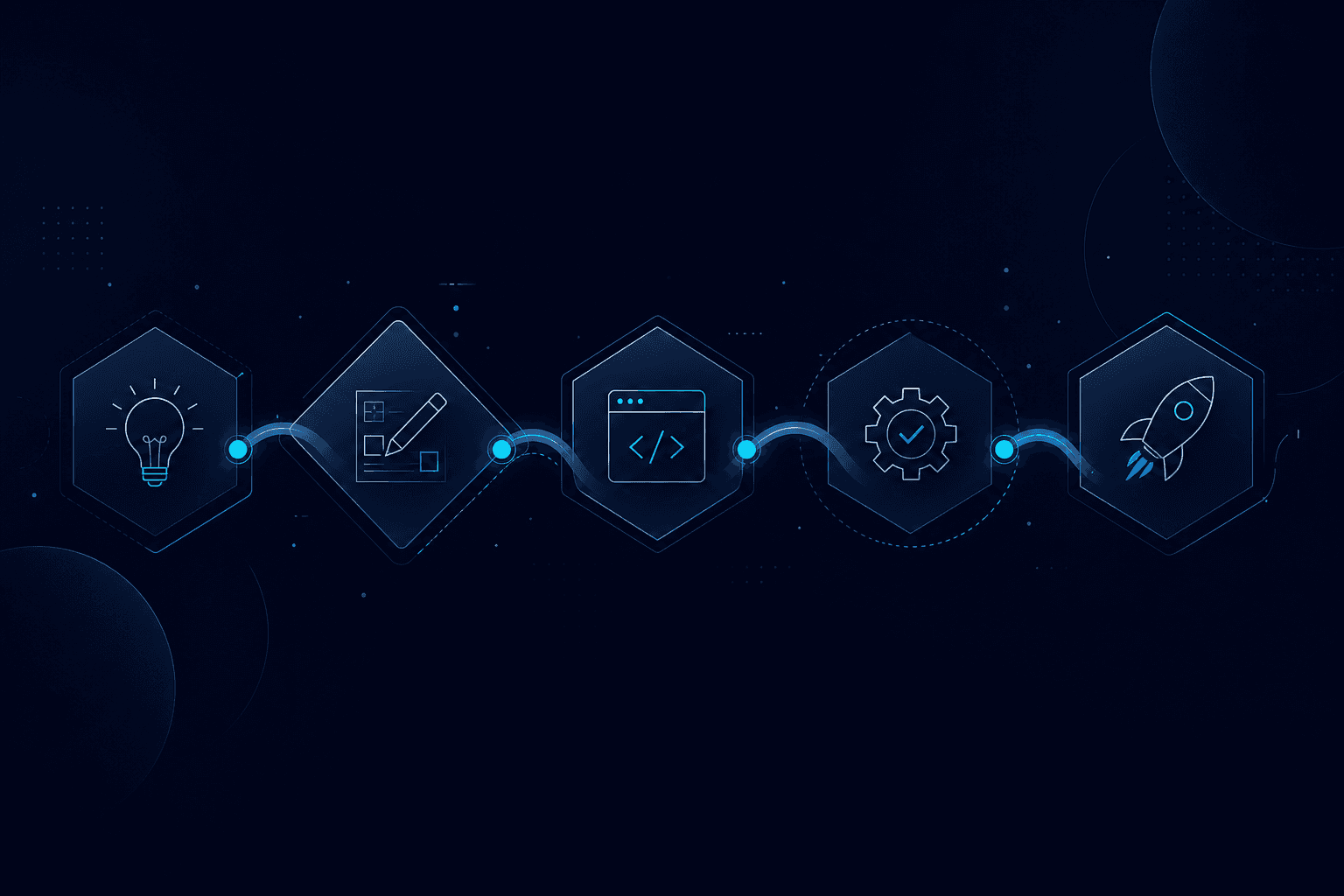
Custom software is not “a more complicated website.” It is a product that must fit your company’s processes, data, and risks — and stay operable after go-live. Below are the stages we follow at UNICORE when building custom software: clarity before code, delivery in waves, and ownership after launch.
1. Discovery & business alignment. We start with problems, not features: who uses the system, which KPIs matter, what systems already exist, what legal constraints apply (GDPR, sector), and what “done” means in 90 days. Typical output: goals, MVP scope, risks, and success criteria. Without this stage, teams build fast — but wrong. If you need framing before build, IT consulting shortens the path.
2. Requirements & user experience. We turn goals into user journeys, priorities (MoSCoW or similar), and clickable prototypes. We validate with real users before freezing architecture. A rejected wireframe costs hours; a wrong module in production costs months.
3. Architecture & technology stack. We choose the data model, APIs, integrations (ERP, CRM, auth), security (identity, roles, audit), and environments (dev/staging/prod). Decisions now set the cost of change in 12 months. We document trade-offs: build vs. buy, monolithic vs. modular, cloud vs. hybrid.
4. MVP & technical foundation. The first shippable increment: authentication, the critical business flow, basic observability (logs, errors), and a CI/CD pipeline. The goal is not “the whole product,” but a core users can test in real conditions. The MVP is a learning tool — not a half-finished version in disguise.
5. Incremental development (sprints). We deliver in short iterations with demos, feedback, and a re-prioritized backlog. Each sprint has a Definition of Done: tests, code review, minimal docs, staging deploy. Transparency on burn-down and risks replaces last-week “surprises.”
6. Integrations, data & security. We connect existing systems, migrate or sync data, and apply controls (encryption, least privilege, backup). We test real edge cases: timeouts, volume, wrong roles. This is where a pretty POC differs from a production system.
7. UAT, training & go-live. Key users validate on near-production data. We prepare a runbook, rollback, launch-window support, and role-based training. Go-live is an operational event, not just a deploy — internal communication matters as much as the pipeline.
8. Hypercare, maintenance & evolution. After launch comes stabilization (real bugs, performance), then a maintenance frame: corrective work, security, improvements. Custom software is an asset — without an evolution budget, it decays. We plan the roadmap by quarter, not “done and forgotten.”
Common mistakes to avoid. Unstable scope without re-prioritization; no client-side owner; integrations left “until the end”; security as an afterthought; success measured only as “we shipped features,” not adoption or time saved. A clear stage process cuts these risks more effectively than any fashionable stack.
At UNICORE we treat each stage as a quality gate: we do not move on without clear criteria. If you want custom software that scales with the business — not just a first release — contact us and map the stages to your case.